

Every year, we put our ear to the ground to understand the biggest challenges DEI leaders face and to capture insight on the latest innovations propelling our industry forward.
We know that none of us are as effective alone as we are together, which is why we’ve distilled the perspectives of 50 forward-thinking DEI leaders into this practical, actionable report.
Before you read on, if you’re interested in getting fresh insights from the movers and shakers who are finding new and innovative ways to scale culture change across their organizations, sign up for our Secrets of Scaling Culture Change newsletter below 👇
6 trends from the past 18 months
The Great Resignation continues (and culture is a critical factor)
While lots of the people we spoke with wanted to reword the phrase “Great Resignation” (The Great Reshuffling, The Great Resistance, The Great Realization), most found that the global phenomenon had hit their organization in one form or another. A recent PwC survey suggests that 1 in 5 in the private sector will re-evaluate their working situations and head for what they believe to be greener pastures in the next 12 months.
"people want a sense of belonging and well-being with their organization"
People will leave bad culture and stay if it’s good –– hybrid working is a major consideration
The data above speaks for itself. Workplace culture matters. As the job market started to tip in favor of employees, they began to ask themselves “why would I stay here if I don’t have to?”.
And when many companies started requiring desk-based employees to head back into the office –– in some cases, full time –– many decided there was no going back. Employees had proved that they could accomplish their work without their manager keeping a physical eye on them, and that became the expectation for a post-pandemic workplace.
The hybrid working debate made fundamental culture issues much more obvious and the impact of an individual manager’s stance on hybrid working became a critical component in a businesses’ ability to retain talent.
It became much easier for employees to spot whether they were working in an environment that had a fundamental lack of trust and flexibility, and whether their organisation really cared about them as a whole person.
For many DEI leaders, coaching leaders and managers to consider the ‘full dimensions’ of a person is a top priority, with an increased focus on things like neurodiversity, varied family structures, and more.
“People don't want work to be my life but they do want their life values to be reflected with the company that they're working for”- Madhavi Bhasin Okta
Of the companies we interviewed, those who were successful at creating a culture worth sticking around for focused on helping to teach leaders and managers new sets of micro behaviors fit for a hybrid world and encouraging them to hold one another accountable to them.
As we adjust to this new world, success comes with changing a thousand small things, not large sweeping gestures that lack long-lasting meaning.
Employees want the companies they work for to care —and act on — social issues
As we learned in 2020 (link to last Pulse report), the more we saw social unrest, the more employees looked to their employers to contribute to meaningful change rather than just pay lip service, and in each of our interviews, DEI leaders talked about the importance of accountability.
Organizations who are truly moving the needle are focused on creating meaningful, measurable progress towards improving in the DEI space –– a critical factor for talent retention that’s no longer optional.
60% of millenials are willing to leave a company if its values don’t align with their own (and millenials now account for 50% of the workforce). Innovators in the DEI space are helping employees understand their own role in DEI, and how to bring others with them on the journey. Almost a decade of work in this space has taught us that the key to creating culture change is to make it everyone’s job.
Frontline workers may have less power than their office-based counterparts, but DEI leaders are keen to make sure they aren’t left behind
It’s important to point out, as one interviewee did, that the ability to shop for a new employer may be more favorable for white-collared workers. And as we head into an economic downturn, where industries like retail or hospitality may be more likely to suffer, it’s more important than ever to remember that just because you aren’t hearing about culture issues from this audience doesn’t mean they don’t exist. Workers may hesitate to speak up if they don’t feel like they have the option to leave.
Women felt the strain as the pandemic stretched into year 3
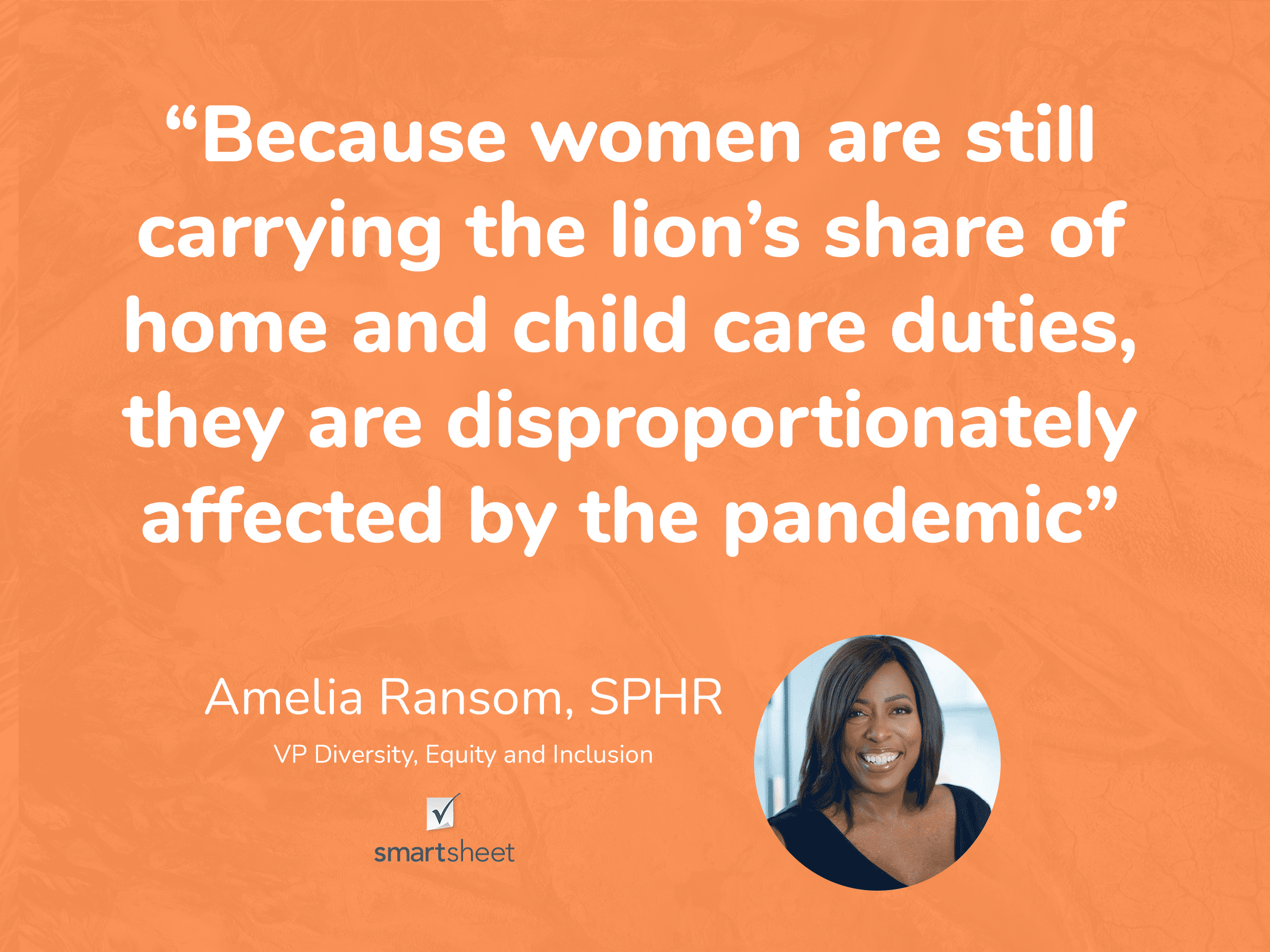
As the Great Resignation kicked into full gear, women were leaving the workforce 4x more than men (NPR). For women who worked from home during the pandemic, the line between work and personal life blurred, as women invested more time in child and dependent care, household responsibilities and virtual education.
A McKinsey study found that burnout and stress were affecting almost twice as many women as men as the pandemic entered a second year. Women are also more likely to do DEI work within an organziation (often outside of their typical job responsibilities) according to the same study. These findings were reflected by our DEI leaders, and many are keenly aware that a loss of women in the workplace could not only set back advances for women’s equality professionally, but could also affect the ability to nourish a healthy work culture. Women also tend to be more empathetic and supportive as leaders, which could cause a ripple effect in workplace cultures.
Though larger societal issues like these may not fully be solvable inside the workplace, the DEI leaders that we interviewed stated that leading with empathy and care is a non-negotiable. While empathy alone won’t solve issues of gender inequity, it certainly can lighten the strain for employees who feel overwhelmed by their lives at home.
Employees felt empowered to hold organizations accountable for pay inequity
With many embracing the opportunity to seek new employment, as you might imagine, pay was one of the top reasons for leaving an organization, with culture as the second. With pay disparity still a known issue amongst certain industries, employees have been calling for accountability in pay transparency from organizations. While the pay inequality conversation may feel like it’s brought up every year, that’s because it’s still not near being fixed.
Some of the DEI leaders we interviewed are attempting to remedy this with transparency. Many organizations are applying industry standard pay scales and auditing to correct any inequities that might occur within race and gender within their companies. Moving forward, many employees may demand that their employers self-report where they stand in regards to pay equity compared to other organizations in similar industries.
Where should DEI leaders focus in 2022 and beyond?
Cultural agility: Be ready to respond to new DEI issues quickly and as they happen
The things people need help with change really quickly, especially in DEI. As DEI leaders, we need to stay agile and help people respond to changes in the world around them quickly eg (some examples of real world things affecting life) and listen to the things people are struggling with eg “I am just terrified about talking to my team about mental health or race”. If people have a space to go to say when they need help and ask questions, then see you'll respond quickly, you'll help them build a positive relationship with DEI and your initiatives. Anonymous quote
We’ve had a lot of conversations about ‘how to keep up momentum’ in DEI in the past few years, but the reality is that new DEI needs are coming to light all the time.
For example, last year the World Economic Forum declared a mental health crisis, this year a climate change emergency –– both issues which increasingly find themselves on the DEI Leaders’ agenda. And headlines continue to impact people in different ways –– from the mental health impact of the War in Ukraine to waves of gun violence across the United States.
The reality is that to keep up momentum on DEI, we must help people associate value with the work of DEI teams by serving them at their point of need. Rather than ‘pushing’ DEI training, the most effective DEI leaders listen to their people to identify where they need the most help. When people understand you’re there to help them, they’re also a lot more likely to respond to trainings that they may need in the future.
Learn more about how Sun Life Financial created strategies to respond to real-world events as they happen >>>
“Companies need to stop with the performative communication and be more genuine” Courtnie Brazier-Barrett Randstad
Difficult conversations: Keeping them going in a hybrid world
As employers have come to terms with the fact that we might be in a hybrid remote environment for the long run, DEI leaders are reflecting on how to build psychological safety remotely and ensure people continue to have important, difficult conversations even when they’re not co-located. The challenge is even more difficult when companies have new joiners that have never met their colleagues in person. How do you have a conversation about a tough topic with a virtual stranger?
The innovators among us start with a level set –– they take the hard thinking out of it by giving people a framework for discussion, and setting expectations about what a positive, respectful, but challenging conversation looks like.
Hive Learning clients start most DEI programs by teaching people how to have a difficult conversation, before offering up discussion guides on thorny topics or giving people conversation starters.
"We want to emphasize accountability through measurement. This helps us remove bias from the process by using quantifiable standards revealing systemic problems, especially ones that make us feel uncomfortable” Expedia
Improving measurement: Making it easier to prove evidence of change and ROI
"We want to emphasize accountability through measurement. This helps us remove bias from the process by using quantifiable standards revealing systemic problems, especially ones that make us feel uncomfortable” Expedia
Measurement was one topic that was on almost all of our DEI leaders’ minds. What is a good way to measure that your DEI plan and actions are having an impact? While some of the companies are trying different strategies in regards to measuring success, others aren’t even sure what metrics are meaningful.
Leaders are learning that some measurements can be moving targets as well. The standard for DEI measurement has been demographics, but some things are harder to measure, like a “feeling of inclusion”. Measuring impact can be tricky as well.
When people think of DEI, they often think of self-reporting demographic data. While that’s one concrete data point to measure, the process of moving the needle in terms of DEI work is behavior change.
We’ve found that the most successful companies we’ve helped scale culture change with were open to continuously checking if behavior had actually changed. Measuring success is more than just a yearly DEI survey, it’s a living and breathing process, and it’s fluid. By the time you’re making changes based on last year’s data, you’re almost a full two years behind the constantly changing DEI space.
When it comes to digital DEI Programs, Hive Learning’s innovators measure three things:
Are people turning up to actually engage with content and conversations around DEI?
This is measured by assessing whether people are showing up to and having conversations in the Hive Learning platform and how frequently they’re returning. They can also analyse this data by cohort to understand which cohorts (cross-functional groups, business units, or regions) are the most and least engaged, as well as being able to spot influencers and detractors.
Outside a digital learning environment, this could equally be measured by whether people are turning up to live sessions or reading newsletters or looking at other resources.
When shown a clear, practical guide to the behaviour they need to change, are people actually committing to changing their behaviour?
In our learning programs, we offer practical behaviours people can put into practice, complemented by regular pulse surveys to gauge whether they have experienced a change in knowledge or understanding, as well as their intent to take action. We also allow learners to schedule reminders, self-report completion and share their reflections with their peers.
Outside a digital learning environment, you could try replicating this using surveys or polls at the end of live sessions or in between.
Do people actually show a change in behaviour? Do their peers report seeing a behaviour change in others?
Using pre, during, and post program surveys, we ask learners to describe whether they are seeing the ‘observable behaviours’ mapped to our learning content playing out in real life. We survey both programme participants and their peers –– a tactic you can replicate whatever your delivery model.
Lastly, we’ve observed a number of innovators taking Hive platform data and mapping it to their business metrics to see if there are positive correlations –– for example, from data in company pulse survey or aggregated from performance reviews.
<iframe title="vimeo-player" src="https://player.vimeo.com/video/575456031?h=53f2cba1b5" width="640" height="360" frameborder="0" allowfullscreen></iframe>
Measuring behaviour change is hard. But many of our DEI Leaders are on a mission to make it easier.
Supporting peers: Especially those in new DEI positions created over the past two years
“When I started this, I felt overwhelmed. This is courageous work. Start where you start, align yourself with other industry professionals and commit to what you say you're going to do” Nancy Harvey New York Power
Many companies are still figuring out their DEI infrastructure, especially those companies who are adding leaders with high ranking titles. How do they fit into the organization? Are they part of the business operations or are they part of the HR structure? Which meetings should they attend to affect change? Every organization is different, especially across varying sectors, so there may not always be a playbook to get these newly minted leaders started, and that can cause a lag on progress.
Many DEI leaders are looking for strategies, playbooks, and trusted partners to help them create a formula for culture change at scale and create impact quickly, and many DEI leaders have committed to making time for their peers to swap challenges, ideas, and perspectives.
While what works may vary from industry to industry, there are always common threads in building culture, and the most effective leaders are the ones that get out there and continue to grow their knowledge.
Think Global, Act Local: Creating global standards with local applicaiton
One major positive effect of the pandemic has been that companies can look all over the world for talent. In some ways, organizations are getting more diverse than ever as their talent pool expands. Our interviewees were faced with a new layer of figuring out the DEI landscape as their worlds suddenly got bigger. Teams have spread out and grown globally, and with that comes the challenge of including new members of the team, which often presents multi-layered cultural challenges.
A key to working through a sudden spike in global diversity is to embrace “glocalization”. Using a “glocal” approach helps organizations build culture from a global perspective with a built in malleability that allows for nimble adaptation at a local level. Much like a marketer needs to think about specific messaging for a specific audience, DEI programs need to have the same flexibility to have effective resonation with subsets of employees who are scattered around the world. You can learn more about how to think “glocally” here.
Investing in Mental Health: Supporting people through challenging times
Mental health was a big theme in talking with our leaders about priorities moving forward. Not just how to implement programs and change, but what types of resources would best help their employees. As the pandemic extended into another year, the strain and stress weighed heavy on employers and employees alike. The need for mental health resources is more imperative than ever. Our DEI leaders found that mental health was a pillar for a healthy work culture moving forward.
Much like the DEI space, everyone will be at a different place in their willingness to be open about their mental health. One way to begin creating an environment where employees feel comfortable with expressing mental health struggles is by creating an environment that feels psychologically safe. The bulk of our DEI leaders felt that just as employees need a safe space for conversations around diversity and equity, that same safe space is needed for discussions around mental health.
One of our aspirations is for our US workforce mirror the US census in terms of race and ethnicity representation- Coca-Cola
Data capture: Expanding beyond demographics and into neurodiversity
Data was on the minds of almost all of our DEI leaders. Not just what data to collect but how to use the data that is being collected. Expanding reporting metrics was a common theme as well, with DEI teams adding additional identities and experiences into their diversity data.
Neurodiversity is is one key measure that can also help make the workplace more accessible for all. As we start to measure more in the realm of DEI, businesses begin to see where they can add strength to their organization. Neurodiversity was likely not on the minds of DEI leaders just a few years ago, but data suggests that hiring with neurodiversity in mind will give your business a competitive advantage, a concept that would have gone unexplored if organizations hadn’t started improving how they measured DEI metrics.
“If you can give people real pathways to select from, they can figure out where they fit in the process. The key to belonging is establishing a sense of communal and individual ownership. Each of us plays a part in the process but we have the autonomy to choose the path that feels most authentic and prioritizes those who have historically been excluded” Expedia
Engagement: DEI Leaders are starting to think like marketers to get meaningful, ongoing engagement
Many of our leaders were still looking for the best ways to engage employees in DEI initiatives, and innovators are starting to run their DEI teams like marketing organisations.
They recognise that just having people engage in a one-off experience isn’t going to result in long-lasting or meaningful behaviour change, but also know that we operate in a world where it’s harder to hold people’s attention than it’s ever been. If you really want DEI to stay top of mind and encourage people to act, you have to start thinking like a marketer.
Some of the innovators we work with at Hive Learning think about this in three modes.
Learn mode
This mode focuses on creating a shared understanding –– building awareness or knowledge, or setting expectations about what the behaviour you want to embed looks like.
We know people can’t operate in an intense learning mode for a long period of time because they have a million other things on their plate. But we also know the forgetting curve is real and that it’s just as critical to make sure people are putting new behaviours into practice as it is to make sure that they learn it in the first place –– which is why we then switch to ‘embed mode’.
Throughout learn mode, we invest heavily in marketing –– promoting programmes at internal events, using regular email newsletters, even posters in the office, and regular, co-ordinated ‘peer driven’ nudges that are delivered as emails, mobile push notifications, or notifications in Teams. All designed to keep bringing people back to the stuff that’s important in a helpful, non-annoying way.
Embed mode
In embed mode, we’re not focused on adding new learning, but we’re still nudging learners (albeit at a much less frequent intensity). But our main goal is to keep new behaviours top of mind and make sure they’re actioned.
It helps to think of this as an ongoing nudge-based marketing campaign. We’re focusing on helping people practice the skills, share reflections, highlight areas they’re struggling with.
And we use peer driven notifications and action checks to remind people to complete actions and revisit previous learnings.
Respond mode
No culture change journey is linear and sometimes you’ll need to respond to new needs quickly. Either discovered through your data (for example, where new requests for help or conversations are bubbling up) or through real-world events (for example, people are struggling to manage their mental health following the news of the War in Ukraine).
Whatever mode you’re in, our leaders tell us that it’s important to think about treating embedding learning just like a brand awareness campaign, where you offer people moments to ‘act on’ just at their point of need.
Accountability: Helping leaders hold one another accountable
“Our communications approach and commitments to DEI has increasingly become part of what we report to our clients. They hold us accountable for it" Carol Watson BCW
One of biggest declarations from our DEI leaders in the interviews was that there must be actual accountability from leadership in organizations. There has been a lot of talk in the past decade or so about DEI initiatives and “doing the right thing”, but leaders often fail to be held accountable when their companies continually fail to register change on paper.
Much like a CEO has to speak to financial losses, organizations’ leaders should be accountable for lack of progress in the DEI realm. DEI has often been a talking point in leaders’ communications but the lack of follow through has started to register with DEI leaders and employees alike as unacceptable.
Many DEI Leaders have been implementing new measures that link DEI iniatives directly to performance measures.
Others are looking for ways to get leaders to hold one another accountable for their behaviour - for example, using group-based learning that helps to get everyone on the same page about what good looks like quickly, and the tools to call out behaviours that aren’t right when they see them. Companies who get this right are not only effective at creating tangible behaviour change among their leaders, but they’re also effective at scaling themselves –– by taking the behaviour change motion out of HR’s hands and putting it into the hands of the people.
In summary, the role of the DEI Leaders continues to evolve at rapid pace. We need to rely on another to help us continue to move forward.
There was a visceral shift in tone we heard from leaders in 2021 in comparison to 2020.
One DEI leader we spoke to pondered if we were all heading for a breaking point and we just needed something major to stop us and truly evaluate what our work/life balance should be.
Now it’s obvious that the landscape has changed again and if you want to retain and recruit the best talent, you need to prove that your employees’ sense of belonging, inclusion, and well-being is at the forefront of your mind.
As we look ahead to the remainder of 2022 and far beyond, it seems we’re in for more turbulence, more new learning needs, and more than ever an opportunity to support one another as we tackle one of the hardest jobs in HR.
DEI Leaders –– we salute you. Thank you for everything you are doing to improve the experiences of folks at work and teaching them things they’ll take home to the dinner table. It’s not an easy job, but we’re so glad you’re doing it.
We’d like to end on a special thank you to all of the contributors who took the time to share their views with us so we could play them back to all of you. Both we and our readers really appreciate it.
--
If you’d like even more inspiration and ideas on how to scale culture change effectively in your organisation, register for our Secrets of Scaling Culture Change Virtual Summit on June 16. You’ll get inspiration and ideas from…
The legendary World-Cup-Winning Coach who led the England team to victory talking about how to scale high performance habits, values and behaviours across 1000s of people
The innovators at the Walgreens Boots Alliance who are taking the tactics used by Instagram’s beauty influencers and transporting them into their digital learning environment to get sky high engagement and better sales results
A former Google MD on network science –– the #1 secret that makes the likes of Facebook, Instagram, and Uber so powerful –– and how to activate the same effect in your culture change programmes to get behaviour change you can measure
--
Thank you to our contributors